sermorelin — Mechanism, Trials, and Safety: Research Evidence
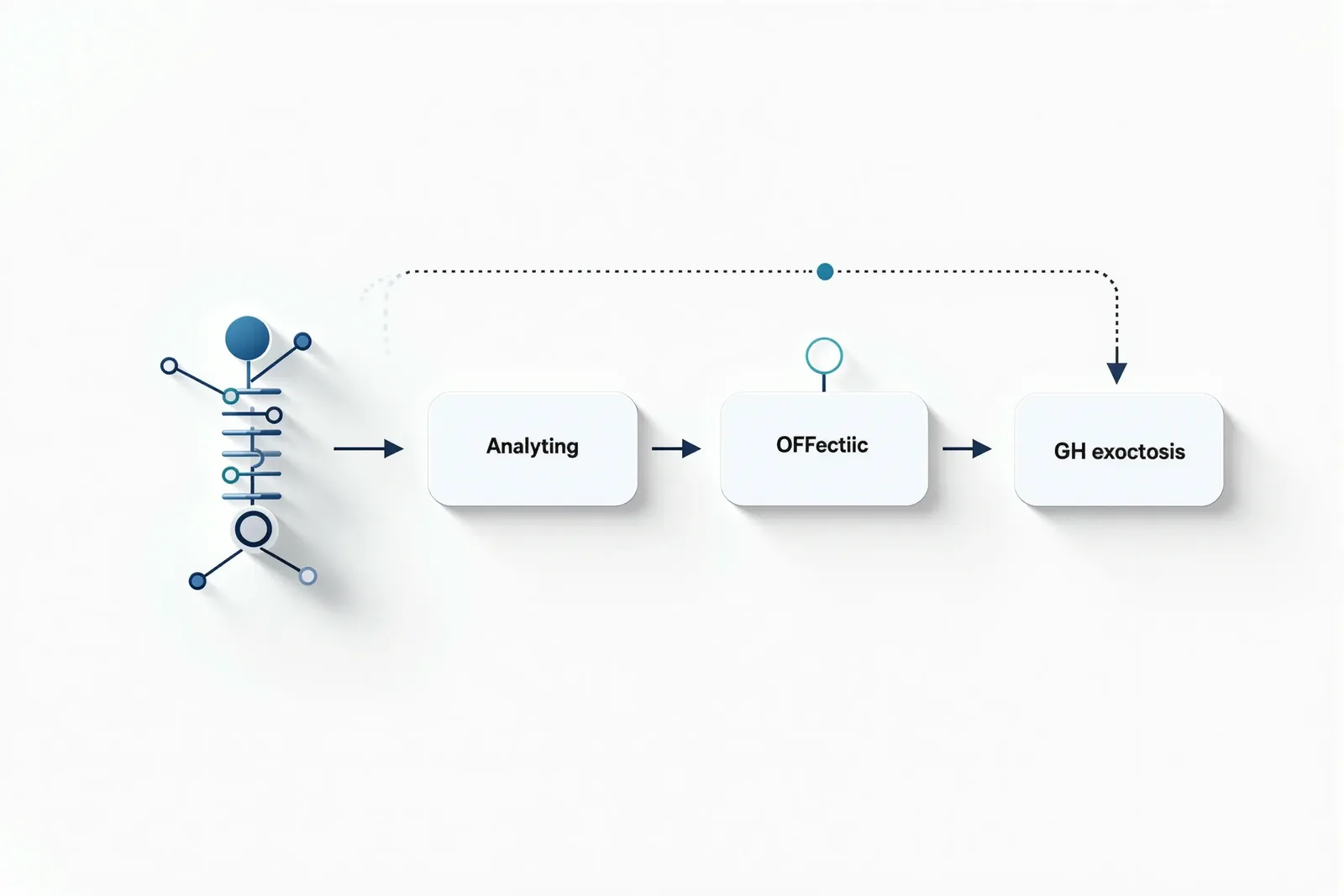
sermorelin's research record spans pediatric GHD treatment trials (FDA-approved 1990-2008), adult GH-secretagogue studies, GHRH-class body composition RCTs, and basic GHRH/sleep physiology. The evidence strength varies sharply by population: strong for pediatric GHD (randomized, multicenter, FDA-reviewed); moderate for adult body composition (class-level evidence from related secretagogues, small sermorelin cohorts); limited for healthy-adult anti-aging endpoints (no large sermorelin RCTs in healthy adults). The evidence-pipeline strip below maps this gradient.
Sermorelin Mechanism of Action
Sermorelin is a GHRHR agonist — it binds the Growth Hormone-Releasing Hormone Receptor (GHRHR), a Gs-coupled GPCR expressed on anterior pituitary somatotrophs [1]. The intracellular cascade: GHRHR binding activates the Gs alpha subunit, adenylyl cyclase elevates intracellular cAMP, protein kinase A (PKA) phosphorylates downstream secretory targets, and voltage-gated calcium channels open, driving GH secretory granule exocytosis [1].
All biological activity of native GHRH resides in the first 29 N-terminal residues — the precise sequence that sermorelin replicates [19]. The 44-residue C-terminal region of native GHRH adds no functional contribution to GH stimulation.
Downstream: GH binds hepatic GH receptors, triggering IGF-1 synthesis. IGF-1 signals via IGF-1R on skeletal muscle (protein synthesis), adipose tissue (lipolysis), and bone (remodeling) [14]. Rising GH also upregulates hypothalamic somatostatin release, which feeds back to pituitary somatotrophs to suppress further GH secretion — the physiological cap on GH output [2].
The somatostatin negative-feedback loop is the mechanistic argument for sermorelin's safety advantage over exogenous GH: the pituitary remains responsive to feedback, whereas exogenous GH bypasses this gate entirely.
Pediatric GHD Efficacy: The Geref Clinical Record
The pivotal efficacy data for sermorelin comes from the Geref multicenter pediatric GHD program. Once-daily subcutaneous sermorelin at 30 mcg/kg bodyweight increased height velocity from 4.1 cm/year at baseline to 8.0 cm/year at six months in prepubertal children with GHD [1]. 74% of children were classified as good responders. No concerning metabolic changes and no excessive IGF-1 generation were documented [1].
A comprehensive review of Geref data classified sermorelin as a rapid and relatively specific diagnostic test for GHD when administered IV at 1 mcg/kg, noting fewer false-positive GH responses versus other provocative tests [2]. Therapeutic subcutaneous dosing at 30 mcg/kg showed meaningful height velocity improvement [2].
Evidence confidence: STRONG. FDA-reviewed, multicenter, randomized clinical program. Evidence class: pediatric GHD. Extrapolation to healthy adult populations requires caution.
Adult Body Composition and IGF-1 Data
The most direct adult sermorelin data is from a study of 14 hypogonadal men treated with GH secretagogues at 100 mcg three times daily: IGF-1 rose from 159.5 to 239.0 ng/mL (p<0.0001) over 134 days [3]. Estrogen-blocking agents attenuated the response, consistent with the known role of estrogen in GH axis priming.
Class-level evidence from GH secretagogue studies fills the gap in sermorelin-specific adult data. A two-year double-blind RCT of ibutamoren (oral GHS acting via the ghrelin receptor) in 65 healthy adults aged 60-81 restored pulsatile GH to young-adult levels, produced a 1.1 kg fat-free mass increase (p<0.001), and achieved approximately 1.5-fold IGF-1 elevation versus placebo; physiological IGF-1 feedback prevented GH overstimulation [11]. A separate randomized multicenter trial of capromorelin in 395 older adults (ages 65-84) found 1.6 kg fat-free mass increase plus significant functional improvements (stair-climb power, tandem walking speed) [16].
GHRH-analog class evidence from tesamorelin RCTs (five trials, meta-analysis) confirmed mean visceral adipose tissue reduction of 27.71 cm2, reduced trunk fat, hepatic fat percentage, and waist circumference, with lean mass and IGF-1 gains and no serious metabolic safety signals [13].
Evidence confidence: MODERATE. Class-level RCT evidence is strong; sermorelin-specific adult RCTs are limited. The 2008 Blackman editorial in Annals of Internal Medicine noted that GH secretagogues were 'not yet ready for prime time' for healthy-adult anti-aging use — a counterpoint grounded in the limited controlled evidence and short study durations available at that time [17].
Sermorelin and Sleep Quality: Research Evidence
GHRH is the principal driver of nocturnal GH secretion. In male subjects, approximately 70% of nocturnal GH secretion episodes align with slow-wave sleep (SWS) stages, and a two- to threefold age-related decrease in both 24-hour GH secretion and SWS occurs between ages 30-40 [6].
Nocturnal GH pulses are more tightly coupled to sleep onset than to SWS stage: when sleep onset was experimentally delayed to 02:00, GH secretory bursts were also delayed and aligned with subsequent SWS [8]. This coupling is the rationale for pre-sleep GHRH analog administration.
A controlled study demonstrated that GHRH administration during the first half of the night increased both GH plasma levels and SWS duration while blunting cortisol release; morning GHRH (04:00-07:00) raised GH without altering sleep architecture [7]. Blockade of endogenous GHRH receptors suppressed 93% of the GH response to a GHRH bolus but did not alter SWS duration or quality, demonstrating that GHRH is required for nocturnal GH pulse amplitude but operates independently of slow-wave sleep genesis [5].
Conclusion from the literature: GHRH receptor agonism augments the nocturnal GH pulse when timed to align with the sleep-onset window; it does not directly extend SWS time.
Sermorelin Side Effects in the Research Literature
The clinical adverse-event pool for sermorelin comes from 350 patients across the Geref clinical trial program [15]. Injection site reactions — pain, swelling, redness — occurred in approximately 1 in 6 patients (approximately 16%). Three patients discontinued due to injection reactions [15]. Other treatment-related adverse events occurred at individual rates below 1% each: headache, flushing, dysphagia, dizziness, hyperactivity, somnolence, urticaria, and nausea [15].
At higher GH elevations: fluid retention (11-100% across different dose regimens in direct GH trials), carpal tunnel-like symptoms, arthralgias, and joint discomfort are documented [12]. These occur substantially more frequently with exogenous direct GH than with secretagogue approaches [12].
Glucocorticoids, anti-thyroid agents, and high ambient free fatty acids can blunt the GH response to GHRH analogs [10]. Elevated free fatty acids reduce GH response via a pituitary-level autoinhibitory mechanism independent of somatostatin feedback [10].
Mild insulin resistance is consistently observed across GH secretagogue trials and requires monitoring of glucose homeostasis [11][16].
Sermorelin Side Effects: classified as WATCH evidence for higher-GH-elevation adverse events in adults (extrapolated from class); ON-TRACK for injection-site and acute adverse-event profile (350-patient clinical trial data, FDA-reviewed) [15].
Sermorelin and Body Composition Research
GH elevation via GHRH-receptor agonism drives two body-composition mechanisms: reduced visceral adiposity (via GH-stimulated lipolysis in adipose tissue) and increased lean mass (via IGF-1-mediated protein synthesis in skeletal muscle) [9][13][14].
The lipolysis mechanism is pulsatility-dependent. Pulsatile GH amplitude, not pulse frequency or tonic GH level, is the primary metabolic regulator of fat mobilization during fasting: GH pulse area under the curve correlated strongly with lipolysis rate (R=0.49, p=0.0015) in a controlled human study [9]. GHRH analog administration preserves the pulsatile pattern; continuous exogenous GH does not [4].
GHRH-analog class evidence (tesamorelin RCTs): mean visceral adipose tissue reduction of 27.71 cm2, significant reductions in trunk fat, hepatic fat, and waist circumference, with lean mass increase — without serious metabolic safety signals [13]. GH secretagogue class evidence (ibutamoren, capromorelin RCTs): 1.1-1.6 kg fat-free mass increases [11][16].
Direct GH supplementation comparator data: 4.3% lean mass increase and 13.1% fat mass reduction over six months [12]. Adverse event burden for direct GH substantially exceeds the secretagogue profile [12].
GH/IGF-1 elevation is necessary but not sufficient for functional muscle gain. Resistance exercise and caloric adequacy are required alongside the hormonal stimulus; IGF-1 receptor density and affinity decline with advanced aging, reducing downstream signaling efficiency [14].
Long-Term Safety Data for Sermorelin
The Geref pediatric clinical trial program found no pituitary hyperplasia, no antibody-mediated loss of efficacy, and no IGF-1 levels exceeding age-matched normal ranges across multi-year follow-up [2]. The somatostatin feedback mechanism that caps GH output is proposed as the primary structural safety advantage over exogenous GH [1].
The two-year ibutamoren RCT in 65 healthy older adults (the most rigorous GHS long-term trial) restored pulsatile GH to young-adult levels for the full two-year period; physiological IGF-1 feedback prevented GH overstimulation; mild insulin resistance was the primary monitoring requirement [11].
Limitations: most adult sermorelin safety data is extrapolated from class-level evidence and small retrospective cohorts. Antibody formation to sermorelin occurs in a substantial proportion of patients on long-term therapy; clinical significance appears minimal but is understudied in adults. Long-term population data in healthy adults are limited — the 2008 Blackman editorial noted this gap remains [17].
Evidence confidence: LIMITED for long-term adult safety specifically. The pediatric record is robust; adult data are extrapolated. GH elevation carries theoretical risk in individuals with undetected malignancy; standard contraindications include active cancer or history of cancer not in complete remission.