sermorelin vs ipamorelin: Research Comparison of GHRH and GHRP Classes
sermorelin vs ipamorelin is the most clinically relevant comparison in the GH secretagogue class — two compounds that activate complementary pituitary pathways and are frequently studied in combination. This page indexes the mechanistic distinctions, the pharmacokinetic profiles, and the research contexts for sermorelin versus ipamorelin, CJC-1295, tesamorelin, and direct HGH.
Sermorelin vs Ipamorelin: GHRH vs GHRP Class
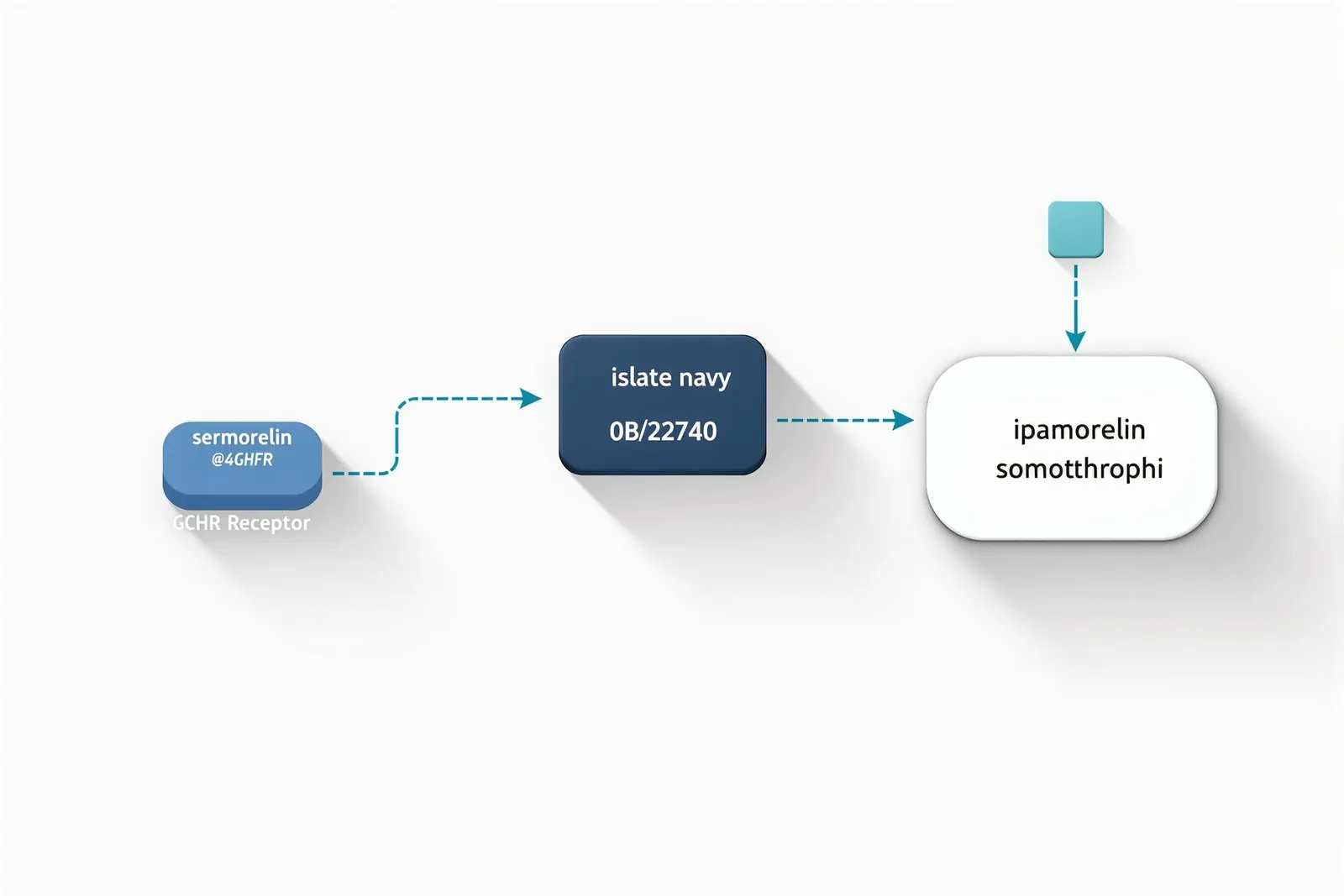
Sermorelin acts on the GHRH receptor (GHRHR) — a Gs-coupled GPCR on anterior pituitary somatotrophs [1]. Ipamorelin acts on the ghrelin receptor (GHS-R1a) — a separate GPCR expressed on both pituitary somatotrophs and hypothalamic neurons [18].
The two pathways are mechanistically complementary. GHRH receptor agonism increases the number of somatotrophs releasing GH per pulse. GHS-R1a agonism increases GH release per individual somatotroph and suppresses somatostatin release — which ordinarily limits GH output [18]. Combined activation of both pathways produces synergistic GH pulse amplitude exceeding either agent alone [18].
In earlier generation GHRP research: GHRP-2 alone produced a 47-fold increase in pulsatile GH, GHRH alone a 20-fold increase, and combined GHRH + GHRP-2 a 54-fold increase versus controls [18]. The combination exceeds the sum of individual responses — a supra-additive result consistent with complementary pathway activation [18].
Ipamorelin is preferred over older GHRPs (GHRP-2, GHRP-6) in modern research protocols due to its selectivity: ipamorelin does not stimulate cortisol or prolactin at study doses, unlike the earlier generation [18].
Sermorelin vs Ipamorelin: Anti-Aging Research Context
Sermorelin has the longer and better-documented human clinical record of the two compounds: FDA approval in 1990 and 1997, a 350-patient adverse-event pool [15], and the Geref multicenter pediatric GHD trials [1][2]. Ipamorelin's human clinical record is thinner — most ipamorelin data comes from small trials and mechanistic studies.
For adult body composition and GH restoration, the strongest controlled evidence comes from GH secretagogue class studies rather than sermorelin- or ipamorelin-specific trials. The two-year ibutamoren (oral GHS-R1a agonist) RCT in 65 healthy older adults restored pulsatile GH to young-adult levels with a 1.1 kg fat-free mass increase [11]. The capromorelin multicenter trial in 395 older adults documented fat-free mass increases plus functional performance improvements [16].
Combination (sermorelin + ipamorelin) versus single-agent comparison: no large randomized trial has compared combination directly against single-agent sermorelin or ipamorelin in a controlled human study. Compound pharmacy protocols combining 100 mcg sermorelin + 100 mcg ipamorelin subcutaneous are in use; the pharmacological rationale is the synergistic GH-pulse mechanism described above [18].
The research literature supports the combination approach mechanistically; the clinical evidence base for combination versus monotherapy in adults is limited.
Sermorelin vs GLP-1 Pathway Agents: Mechanistic Differences
Sermorelin and GLP-1 receptor agonists (such as liraglutide, semaglutide, or tirzepatide) operate on entirely different biological axes and have been studied for fundamentally different research purposes.
Sermorelin acts on the GH/IGF-1 axis: GHRHR agonism in the anterior pituitary drives pulsatile GH secretion, which mediates anabolic and lipolytic downstream effects [1]. GLP-1 receptor agonists act on the gut-brain-pancreas axis: GLP-1R agonism stimulates glucose-dependent insulin secretion, suppresses glucagon, delays gastric emptying, and reduces appetite via central GLP-1R signaling [13]. These are separate molecular targets, separate physiological pathways, and separate bodies of clinical trial evidence.
For visceral fat reduction specifically, GHRH-class analogs (tesamorelin) have been studied in RCTs and demonstrated mean 27.71 cm2 VAT reduction [13]. GLP-1 pathway agents reduce body weight more broadly (including subcutaneous fat) through energy intake reduction — a different mechanism from the pulsatile-GH-driven lipolytic pathway.
The question 'is sermorelin better than GLP-1?' does not have an answer in the research literature because no head-to-head comparative trial exists and the mechanistic targets are non-overlapping.
Sermorelin vs CJC-1295: Structural and Pharmacokinetic Differences
Sermorelin and CJC-1295 are both GHRH receptor agonists — both activate the same GHRHR target. The critical difference is pharmacokinetic, not mechanistic.
Sermorelin is the unmodified GHRH(1-29) sequence. Plasma half-life: approximately 11-12 minutes. DPP-4 cleaves the peptide rapidly; absolute subcutaneous bioavailability is approximately 6% [4].
CJC-1295 incorporates amino acid substitutions at positions known to be DPP-4 cleavage sites, extending plasma stability. CJC-1295 without DAC: approximately 30-minute half-life. CJC-1295 with DAC (drug affinity complex moiety): 6-8 day half-life via albumin binding [19].
The consequence: sermorelin produces a GH pulse pattern closely approximating endogenous GHRH dynamics — a sharp, short, feedback-gated burst aligned with the nocturnal secretory window. CJC-1295 with DAC produces a sustained GH/IGF-1 bleed that differs fundamentally from pulsatile physiology [19]. The clinical significance of this pharmacokinetic difference — whether pulsatile versus sustained is superior for body composition, safety, or other outcomes — has not been directly compared in a randomized trial.
Sermorelin's shorter half-life requires more frequent dosing to achieve the same daily GHRH stimulus. CJC-1295 with DAC is typically dosed once weekly or once every two weeks in research protocols.
Sermorelin vs Tesamorelin: How They Differ
Sermorelin and tesamorelin are both GHRH analogs acting on GHRHR. The structural difference: tesamorelin incorporates a trans-3-hexenoic acid modification at the N-terminus that increases peptide stability and GH pulse magnitude relative to native GHRH, without the extreme half-life extension of CJC-1295 DAC [13].
Tesamorelin is the only GHRH-class compound with FDA approval, approved specifically for visceral adiposity in HIV-associated lipodystrophy [13]. The pivotal RCT program (five trials, meta-analysis) documented mean 27.71 cm2 VAT reduction, plus significant reductions in trunk fat, hepatic fat percentage, and waist circumference, with lean mass and IGF-1 increases [13]. This is the strongest controlled human RCT dataset in the GHRH analog class.
Sermorelin was FDA-approved for pediatric GHD (a different indication and population) and does not have equivalent visceral fat reduction RCT data [1][2][12]. The mechanistic case for sermorelin in body composition derives from class-level evidence and the GH-axis physiology; the RCT evidence base is tesamorelin's, not sermorelin's.
Tesamorelin is studied as a comparator compound and reference point for GHRH-class efficacy — not as a combination partner with sermorelin.
Sermorelin vs HGH: Mechanism and Regulatory Context
The mechanistic distinction is foundational. Sermorelin stimulates the anterior pituitary to produce and release endogenous GH in pulsatile bursts, with the somatostatin feedback loop intact to cap peak output [1][2]. Exogenous HGH bypasses the pituitary entirely, delivering GH directly to circulation, suppressing endogenous GH secretion, and eliminating the pulsatile pattern [12].
Consequences of bypassing pulsatile physiology: exogenous GH produces a sustained GH exposure rather than the episodic bursts that drive physiological lipolysis [9]. The pulsatile GH amplitude — not tonic level — is the primary regulator of fasting lipolysis [9]. Additionally, fluid retention occurred in 11-100% of patients across direct GH trials, carpal tunnel-like symptoms in 7-50%, and arthralgias in 14-77% — substantially higher adverse event rates than the secretagogue literature [12].
Regulatory context: FDA-approved recombinant human GH forms are prescribed for specific diagnosed conditions. Sermorelin was FDA-approved for pediatric GHD; Geref was withdrawn in 2008-2009 for commercial reasons, not safety [12]. Compounded sermorelin has no FDA approval; a licensed clinician assesses the patient before deciding whether to prescribe it [12].
Athlete regulatory context: WADA and USADA classify GHRH analogs, including sermorelin, as prohibited substances under S2: Peptide Hormones, Growth Factors, Related Substances and Mimetics. Prohibited in-competition and out-of-competition. Both exogenous GH and sermorelin are prohibited under WADA rules.